Mary Poppins and the Shamanic Way

Sometimes, our earliest teachers come in the form of stories.
Sometimes, they arrive on the wind.
May we all remember the magic that hums beneath the surface of our ordinary days —
and may we have the courage to fly when the wind invites us onward.

As my life has unfolded in ways no suburban child could have imagined, I have found myself drawn again and again to those who walk between worlds — shamanic healers from distant countries and ancient traditions. My mind delights in the threads that weave them together: songs that heal, prayers whispered to the wind, and the steadfast belief that the seen and unseen are in constant conversation.

The word shaman itself is rooted in the frozen soils of Siberia, long before it drifted into our shared language. To my ear, it hums in harmony with other sacred words: curandera from the heartlands of Mexico and Central America, or mystic in English — each describing one who listens for what others cannot hear, one who knows that the veil between worlds is thin.

When I look back across the winding path of my life, tracing the first seeds of my fascination with mysticism, I find — to my surprise — that Mary Poppins was one of my earliest teachers.
Yes, Mary Poppins! A Disney character! An English nanny with impeccable posture and an umbrella that talks!
And yet — magic often hides in plain sight.

Her first appearance gives it away. She descends from the heavens, riding the wind, a talking parrot perched upon the handle of her black umbrella. She tucks that impossible object neatly into her carpetbag — a container that, like the shaman’s bundle, holds far more than it seems. The air shimmers. The children are spellbound. The adults, entranced by their own routines, fail to notice.

In that, Mary Poppins reveals a core truth of the shamanic path: those who are meant to see, will see. Those who are ready, will recognize the medicine. The rest continue on, unaware that the miraculous has just walked through the door.

Mary sings her spells. She teaches through vibration and joy — a spoonful of sugar to help the medicine of awakening go down. Her songs are incantations: Supercalifragilisticexpialidocious, I Love to Laugh, each one a doorway to altered consciousness. Through rhythm and laughter, she raises the vibration of those in her care.

Then, as true shamans do, she opens the way between worlds. Hand in hand, she and the children leap into a chalk drawing on the sidewalk, entering another realm altogether — a place where color, play, and delight reign supreme. They meet a man who teaches them that laughter can lift not just spirits but bodies. They learn that joy itself is a portal to freedom.

Through her mysterious ways, Mary Poppins midwifes transformation. A small boy’s wish to feed the birds becomes the spark that topples rigidity and awakens compassion. The true healing that unfolds is not just in the boy or his father but in the entire family — hearts reunited, love restored, values reborn.

And when her sacred work is done, the wind shifts.
Mary feels it in her bones.
Without fanfare, she opens her umbrella, rises into the sky, and sails away — as all true healers must — toward the next soul in need of remembering.

This is the essence of shamanic healing: invisible, profound, devoted to love. It is not about spectacle; it is about restoration — the mending of what has been forgotten, the rekindling of joy, the return of wonder.

The final scenes of Mary Poppins show a family realigned with truth, walking hand in hand beneath the open sky. The spell is complete.

I will forever be grateful to Mary Poppins — and to those who brought her magic to life, P. L. Travers and Walt Disney. Through her, a doorway opened in my young suburban heart, revealing that enchantment is real, that laughter can heal, and that love — always — is the deepest medicine.
When Kindness Becomes Self-Abandonment


There comes a moment when you realize the love you give to others must be matched by the love you give yourself. This is not a selfish act—it is the very soil in which your well-being grows. Without tending those roots, your empathy can become an open door for harm. But when you nurture your own ground, your compassion deepens, your boundaries strengthen, and you bloom in ways no storm can undo.

It was just a brief talk—about those of us who carry too much empathy—that lit a quiet spark in my mind. From that spark came a deeper contemplation: the nature of accountability, especially in the tender, tangled terrain of intimate relationships.

So often, we long for our partners to “own their part,” to step forward with honesty and humility. But the truth is both humbling and liberating: we can only ever tend to our own part. That doesn’t mean we are always wrong, or that we accept abuse—it simply means that our power lies in choosing when to engage, and how to respond.

For most of my life, I have sincerely endeavored to respond with empathy, even in the difficult deeply challenging moments. That was my compass, my instinct. But what does empathy look like when a partner’s words cut or their hands harm? Is empathy still kindness then—or is it a potentially disastrous form of self-abandonment?

I remember giving more than one partner a pass on his anger because he had revealed to me the deep sorrows of his childhood. Then I gave another pass. And another. Until one day, something inside me broke open and I ended the connection. It felt like the only way to breathe again. I have never regretted those choices. What I have regretted are the painful moments I failed to stand for my own well-being—when I accepted behavior that was not only unpleasant, but dangerous to my body, mind and spirit.

Over time, I’ve learned this: I would rather gather the lessons from a painful experience than cradle the heavy stone of regret. So I began to rewire my inner landscape—upgrading the old operating system of blame and self-reproach into something cleaner, clearer. Something rooted in awareness. The tools are simple and ancient. Meditation, self-reflection and honesty.

I had to learn—deep in my bones—that my well-being is mine to protect. No one else will do it for me, nor would I ask them to. We are each responsible for our actions, even when we can trace them back to the wounds of childhood. Awareness is the first step, always. Without it, accountability has no soil to grow in.

But awareness does not arrive easily. Shame and guilt rise can and will rise like storm clouds, obscuring the view. It can feel unbearable to admit—to ourselves, before anyone else—that we have acted in ways we wish we hadn’t. And yet, there is courage in turning toward that inner mirror with an unflinching gaze, in seeing the whole of ourselves, and in meeting that reflection not with condemnation, but with love. This, my friend, is true freedom.

And maybe that is the quiet miracle: to hold ourselves with the same tenderness we have so freely offered others, to place our own well-being in the center of the garden, and to tend it faithfully. For when we do, our empathy is no longer a doorway for harm—it becomes a light that guides us toward relationships where love and respect can truly take root and flourish.

Love – the mirror

The shadow part of our unconscious has a talent and desire to cause trouble for us. So it becomes of paramount important to find a way to prevent the meddlesome troublemaking of our shadow sides.

I have lived most of my life believing that love is always positive, that love only speaks the kindest truth… that love sees with the heart. And I still believe this but as a new way of discerning kindness has been shown to me. It has become very clear to me that a very effective way to see ourselves is to use love, friendship or intimacy as a mirror and allow the love to open us more fully to ourselves and also to see the places we may not see clearly ourselves. Only in a trusted connection of friendship and real love can this function in the highest way.

There is a necessity to be able to face all of ourselves, the light and the dark to continue growing and expanding in higher consciousness. Our shadow side is sneaky, when we look there, our shadow diappears! It can only be seen by looking behind and those who have the best view are often outside ourselves. Our friends and family can help us to become the people we want to be with loving feedback and observation.

This is tricky turf, though. In many relationships and families most of us have witnessed this process being subverted through criticism and verbal abuse. The eyes of love do not see in a judgmental way. Love is patient, love is kind… love especially is kind.

Cultivating relationships and intimacies with others can help us see where we are on the path – “as within, so without”. What kinds of friends do you have? How are they reflecting your shadow side back to you? Awareness is the first big step towards change and healing.

There is another sneaky way the human mind can cloud the mirror, and it is fairly common and very hard to detect from the inside. It is called “projection” where we imagine others to be making us our victims when we are also enacting the behavior we judge in others. By listening to our own judgements of others we can learn to perceive ourselves more clearly, clean our mirrors and heal the ways we judge ourselves and project that outward into the world.

Our shadows want to be seen, to be acknowledged and respected. When that doesn’t happen there are some interesting ways the shadow demands attention. For one there can be a tendency for those with troubled feelings to find someone to whom they can “confess” their darker thoughts and tendencies. It is a cry for help, and a cry for loving attention. The shadow part of our unconscious has a talent and desire to cause trouble for us. So it becomes of paramount important to find a way to prevent the meddlesome troublemaking of our shadow sides. This really is BIG work. Therapists are one powerful avenue towards self -love, and it is important to feel support and respect in that relationship. Close friends can also help us, as can intimate partners. The enmeshment of intimacy does seem to cloud things though and it may not be best to depend on your partner for this support. Sometimes it works to engage in “co-counseling” with a friend where you share time, each giving and receiving emotional support and loving feedback.

I love to contemplate the story of the Chinese Goddess of Compassion – Kwan Yin. She is so filled with love and compassion that she actually rides a dragon to her destination. I understand this to be the illustration of the truth that only love, more love and more compassion can fully integrate the powerful, fiery, potentially destructive parts of our psyche into balance to serve the highest good.

How have you tamed your dragons today? Let’s talk!

Exiting the Chrysalis

th

I have spent countless hours observing caterpillars, chrysalis and butterflies.  I have witnessed the challenge, the risk and the glory of metamorphosis.  Each transition is difficult – when the caterpillar hatches it is fine food for birds, lizards and other critters.  As they grow into adulthood, the caterpillar needs to find a safe place to cocoon.  This is not an easy search for such a small being, and there are many hazards on the way.  Once again, they can be eaten by birds, or other creatures, crushed by man or animal or run out of time in their quest.

When the caterpillar finds a suitable place (or unsuitable, time will tell, a Monarch caterpillar once made its chrysalis on a hinge and almost made it until an unwitting guest closed the door… sadly…) I digress – It attaches to the wall.  It needs to hold on in order to let go. That always tickles me to say, paradoxes are my thing!  Then comes the intense part as the caterpillar’s body seems to dissolve.  Sometimes they just don’t make it through this process, it can’t be easy.  If they do make it then they become another kind of being.  A being stopped in time.  Some of them have little faces, others look like dangly jade earrings but all of them are specialized and precise.  For in some period of time, from a couple of weeks to a couple of years, the butterfly will emerge.

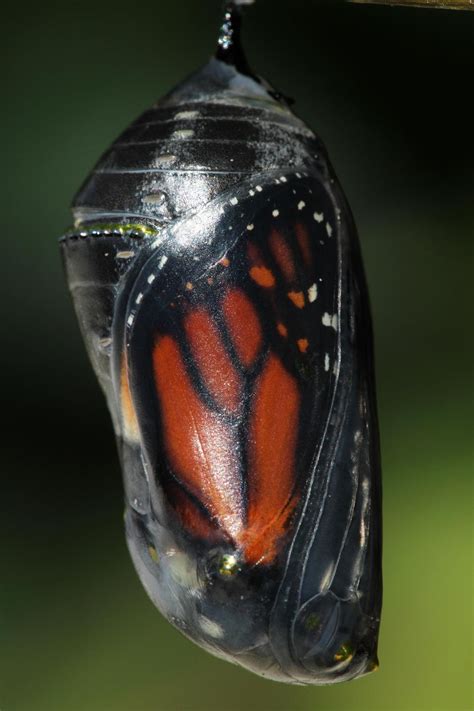
The monarch butterfly emerging is a miracle of nature I’m overawed to have witnessed many times.  As the jade green chrysalis approaches hatching time, the skin begins to become transparent and the butterfly inside is seen as a kind of origami puzzle.  When it breaks out of the cocoon it is a fragile being.  It takes time to dry off its wings and is very vulnerable for even a gust of wind can knock it to the ground and its wings will deform.  They can’t take off yet so are at the mercy of any nearby bird.  And yet, many of them flutter happily (I project) into the sunlight.  Butterflies can’t fly in cold weather so they are always beacons of springtime.

Once they are aloft they have two activities to fulfill.  They sip nectar and aid in pollination as a side effect.  They make love and procreate.  I once watched a monarch butterfly couple do their coupling for almost an hour.  When it was complete, he (I imagine, perhaps wrongly) lifted her up and flew her up to a branch where they rested for a while.  It’s a short life, but valuable for sure.

Why am I rambling about this right now?  We’re quarantined to be safe from the corona virus, we’re watching our world come to a standstill.  We are cocooned.  It is a challenge perhaps the biggest challenge of our short lives.  Life, as we imagined it was, has ceased to be.  We have let go, collectively and individually.  We have let go of activity for the most part.  We’re not allowed to gather or recreate together.  It’s very strange.  It seems unnatural.  For those of us who have meditated and vision quested it is not difficult but most people have spent their lives avoiding being alone and quiet and listening to their inner voice.

What’s next?  I imagine us, like the butterfly, emerging slowly from this cocoon.  Taking it one tiny step at a time, into the sunlight.  Everything has shifted and I hope that we can collectively make more loving choices as we recreate our systems to better serve humanity and our ecosystem.  There are some important things each of us can do to contribute and “be the change”.  We can get comfortable with ourselves, honest and true and be clear on what we stand for.  I stand for love, for caring, for holding each other up with nobody left behind.  I think a basic universal income and guaranteed housing would be a fantastic place to start.  All the money spent on the war machine can be turned to providing that and health care, education and funding for the arts.  Animal agriculture should be ended and hemp and cannabis farms allowed to prosper and provide.

The sky is the limit!  What kind of world do you want to live in?  Keep marinating in your cocoon and we can discover that together….I love you!

Understanding is Peace

“Oh Lord, please don’t let me be misunderstood”  lyrics from Love Potion #9

Being misunderstood creates a complicated series of emotions.  Frustration, confusion, anger, sadness cascade around inside a confused mind.  How can I be more clear?  How can I express myself in a way that can be understood?  Understanding is peace – recognition feels so good, and when a communication is received through a clear filter, hearts open, joy arises.  Layer the filter with insecurities, resentments and bad memories and misunderstandings can build to a crescendo of confusion.

“Why did you say that?  Why didn’t you say it a different way?  Why Why Why?”  Many abusive conversations start this way – it has just occurred to me that those conversations in which we are told (usually angrily) that we should have done something differently are in fact abusive – since none of us can change the past.  What would kindness say?  I’m delving into some other ways to communicate that will be more effective, more kind and way more understanding.

There are many systems who aim is to remedy this kind of situation.  Most of them would recommend staying away from the written word, as inflection calls for assumption, which is the beginning of a slippery slope and a downward slide.  I love the book “The Four Agreements” which proposes a simple set of rules for staying on the positive side of discussions and conversations.

“Don’t Make Assumptions” is a rule that can often clarify misunderstandings.  And oh how assumptions can multiply in a texting barrage.  Oh dear!  What is the remedy?  To ask for clarity, to be open to receiving it instead of clinging to the original assumption, which has come from a clouded place – often dark.  If we are going to make assumptions, it might be best to assume loving motives – albeit this can cause romantic confusion from time to time.  Once again, just simple clarity can alleviate many kerfluffles.  Simplicity rocks!

“Don’t take anything personally” – is another “rule” that is often forgotten.  All of us have a unique perspective, a personal view.  We can sometimes see clearly, but vision is once again clouded by our personalities and histories.  Finding a way through to an open hearted perspective does bring us to the Promised Land of love.  Bringing this teaching close to heart has helped me many times.  “We don’t see things as they are, we see things as we are” said Anais Nin, in a fit of wisdom.  “you, you, you” says the ego – if only “you” did something differently, I would be able to love you.  Sigh, squirm, deflect, resist….

These two suggestions come up often for me.  They can effectively guide me back to a place of understanding that includes seeing myself and others with compassion and love.  If I still can’t get there I can turn to NVC or Non-violent communication.  That system is based on the idea that criticizing and judging others (if only you had ________, I would be ok) is violence.  It certainly isn’t the path of love or kindness.  I haven’t met a person yet who could turn back the clock and re-do the past.  It is a superpower many of us may wish for from time to time, but what we have is this moment, this opportunity, this love.  NVC says to speak of feelings, instead of our judgements of other.  “When you did X, I felt Y” as opposed to “why didn’t you do that differently, what’s wrong with you, now I’m mad”… And this is easier than it sounds, most of us have underdeveloped vocabularies for feelings due to centuries of emotional repression and interrelations that are based on anger and rage.  NVC includes a handy reference guide to feelings – and a reminder that when we say “I feel like you are ________” is not a feeling, but a judgement.

I recently learned that when we say “I feel” it is most likely to express genuine emotion.  When we say “I feel like” then the contemplation has returned to the mental realms of criticism and closed hearted judgements.   These are fine points, I know as we stumble along on the day to day experience of living life as a learning process heading towards love.  And just as an unfinished painting doesn’t include the finer details, an unfinished comprehension is the same.  Filling in the details, being aware of the finer points, paints a different picture.  Be an artist!  Make your life be your masterpiece of understanding.  It’s more fun that way, I am sure of it!

and then, when all else fails – there is a beautiful system called Ho’o’ponopono which goes something like this:

I’m sorry, I love you, please forgive me, thank you….

repeat, repeat, repeat until you get it right….